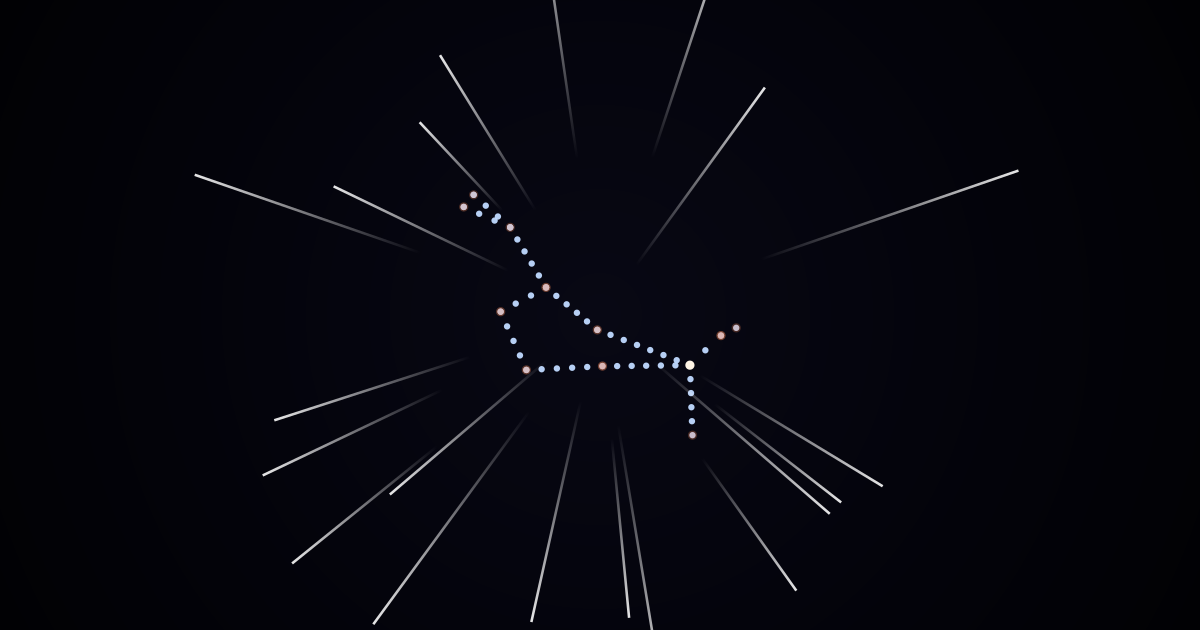
Quadrantids 2027: the short, strong meteor shower of January
The Quadrantids are one of the strongest meteor showers of the year. In 2027 the peak is on January 4, at about 03:20 UTC.
The rate at the peak is about 120 meteors an hour. That number is for a perfect sky, with the radiant overhead. From a dark place you see fewer, but still many.
The catch: the peak is short. The best rates last only a few hours. If the peak falls in your daytime, you see much less.
This year the Moon helps. It is a thin crescent, about 12% lit, and it rises only a few hours before dawn.
When to look
- Europe and Africa: the night of January 3 to 4, in the hours before dawn. The peak falls in your night. This is the best place to be.
- North America: the night of January 3 to 4, after midnight. The peak is in your evening, and the radiant is low then. The rates fall after the peak, but the late night still shows some meteors.
- East Asia: the peak falls in your daytime. Try the early morning of January 4, before dawn, but expect fewer meteors.
The Quadrantids are a shower for the northern half of the world. From the south, the radiant stays low or does not rise at night. In Sydney it rises only at dawn, so you see almost none.
The radiant is low in the evening and climbs all night. The hours before dawn are the best.
Where to look
The meteors seem to come from a point in Boötes, near the handle of the Big Dipper. But they cross the whole sky. Look at a wide part of the sky, about halfway up.
See the Quadrantids on the live sky map, from your place, at the best time to look.
Where to go
A dark sky shows many more meteors than a town sky. Find a park or a reserve in our list of stargazing places, or see the dark places for the Quadrantids in your country.
How to watch
- Dress for a very cold night. January in the north is the hardest month for this.
- Bring a warm drink and a blanket.
- Lie back on a chair or a mat.
- Put your phone away. Your eyes need 20 to 30 minutes in the dark.
A name from an old map
The name comes from Quadrans Muralis, a star pattern on old maps of the sky. It is no longer used. Most of its stars are now part of Boötes. The shower probably comes from an asteroid, 2003 EH1, that may be an old, dead comet.
More sky guides
The Christmas Eve full Moon 2026, the closest of the year
The full Moon of December 24, 2026 is the closest of the year, 356,738 km away. It looks a little bigger and brighter than usual. When to see it rise.
Uranus at opposition 2026: how to find the green-blue planet
Uranus reaches opposition on November 25, 2026, near the Pleiades. A full Moon is close that week, so early December is best. How to find it in binoculars.
The best dark-sky places in the United States
9 certified dark-sky places in the United States to see the Milky Way, from the deserts of the Southwest to the forests of Pennsylvania.