Mars at opposition 2027: the red planet in Leo
Mars reaches opposition on February 19, 2027, at about 15:50 UTC. At opposition, Earth is between Mars and the Sun. So Mars rises at sunset, is up all night, and is at its brightest for about 2 years.
At opposition it is at magnitude -1.2. Of all the stars, only Sirius is brighter. Its orange-red color makes it easy to find.
When to look
Mars rises in the east at sunset. It is highest near midnight.
Mars stays bright for weeks before and after opposition. The full Moon comes on February 20, so the nights near opposition are bright. That does not matter much for Mars. Mars is bright enough to shine through moonlight.
On the night of February 20 to 21, the full Moon is close to Mars, about 5 to 7 degrees away. That is a good night for a photo.
Where to look
Mars is in Leo, about 4 degrees from Regulus, the brightest star of Leo. Look east in the evening, or south near midnight. From the south of the world, look north near midnight.
Jupiter is close by, about 10 degrees west of Mars. Jupiter is the brighter of the 2.
See Mars on the live sky map, from your place, at the best time to look.
What you can see
- With your eyes: a bright, steady orange-red point of light.
- With binoculars: a brighter orange point. Binoculars do not show a disc.
- With a telescope: a small disc. On a steady night, with high power, you may see dark areas on the ground, and sometimes a white polar cap.
Why this opposition is far
Earth passes Mars about every 26 months. Mars has a stretched path around the Sun, so the distance at each pass changes a lot.
On February 20, Mars is at its closest to Earth, about 101 million km away. At the best passes, Mars comes closer than 60 million km, and it looks about 1.8 times wider. 2027 is one of the far passes. Mars still looks good, but it looks small in a telescope.
More sky guides
Jupiter at opposition 2027: see its moons with binoculars
Jupiter reaches opposition on February 11, 2027, in Leo. It is the brightest thing in the night sky after the Moon and Venus. Here is when to look, and what binoculars show.
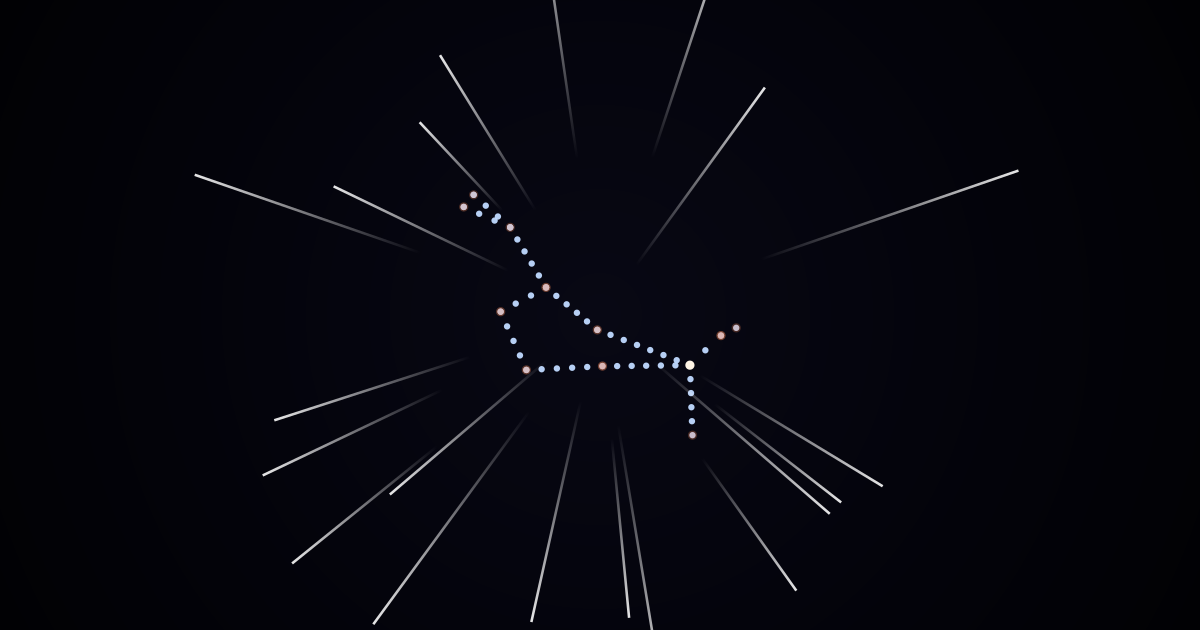
Quadrantids 2027: the short, strong meteor shower of January
The Quadrantids peak on January 4, 2027, at about 03:20 UTC. The peak is short, and the Moon is a thin crescent. Who gets the best view, and when to look.
The Christmas Eve full Moon 2026, the closest of the year
The full Moon of December 24, 2026 is the closest of the year, 356,738 km away. It looks a little bigger and brighter than usual. When to see it rise.